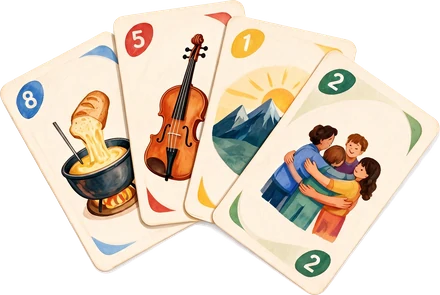
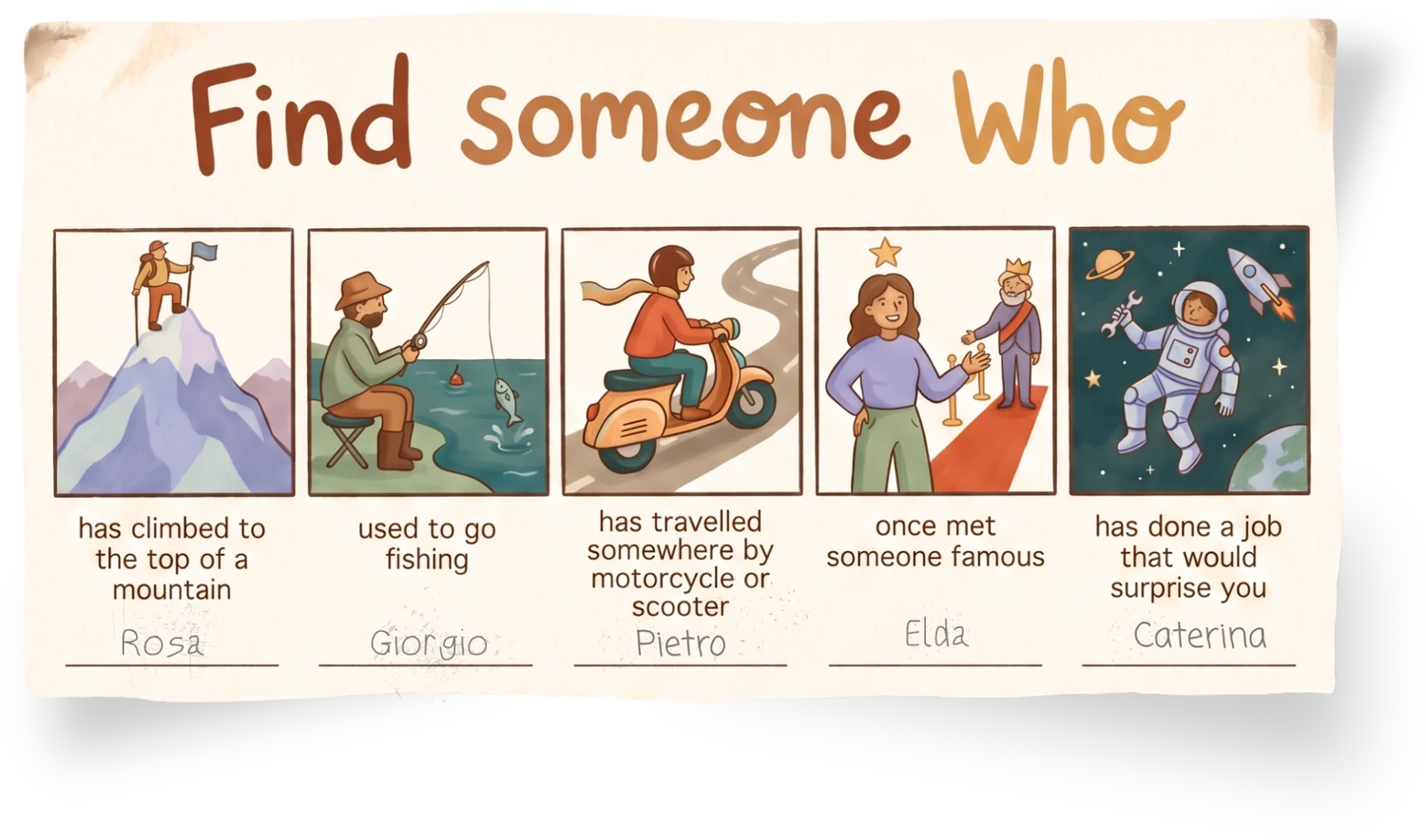
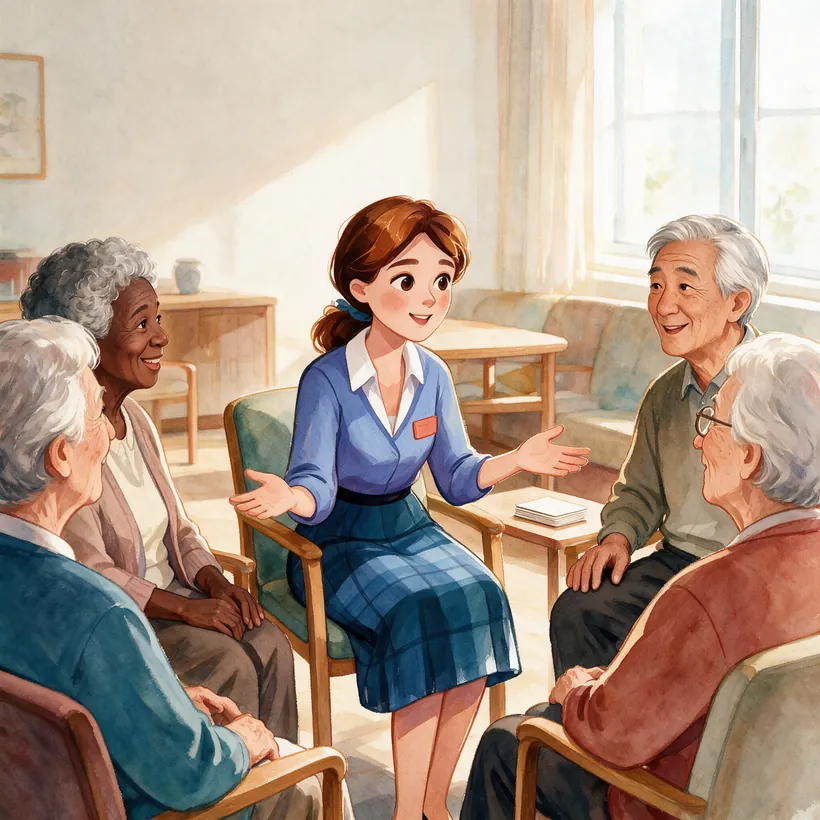
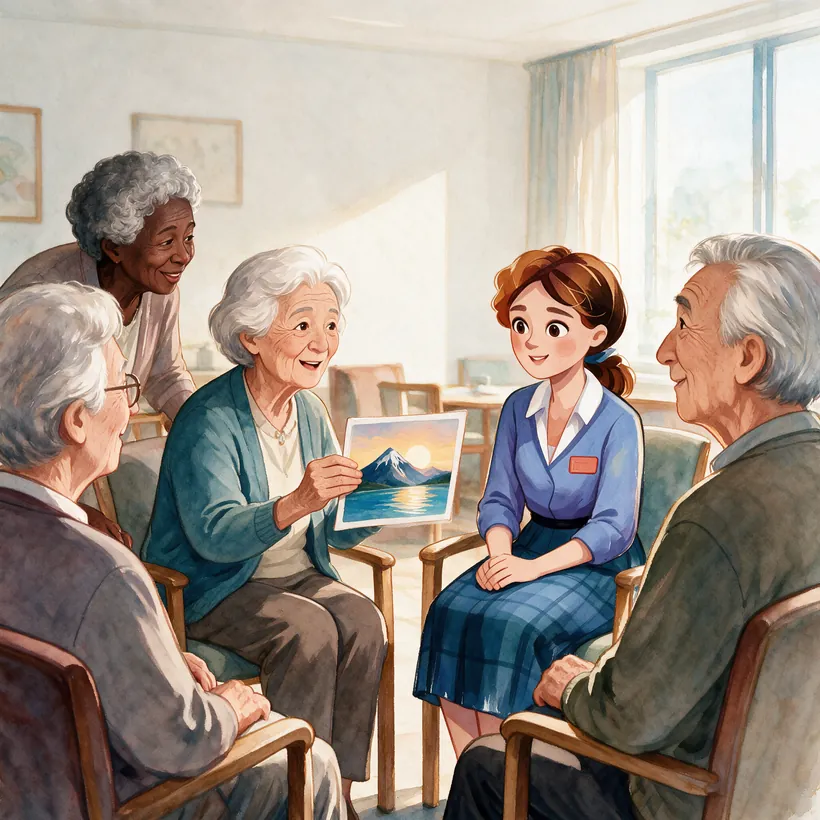
A group activity designed for care homes. Images, simple words and memories guide a relaxed, unpressured conversation. No English is needed: every resident takes part at their own pace.
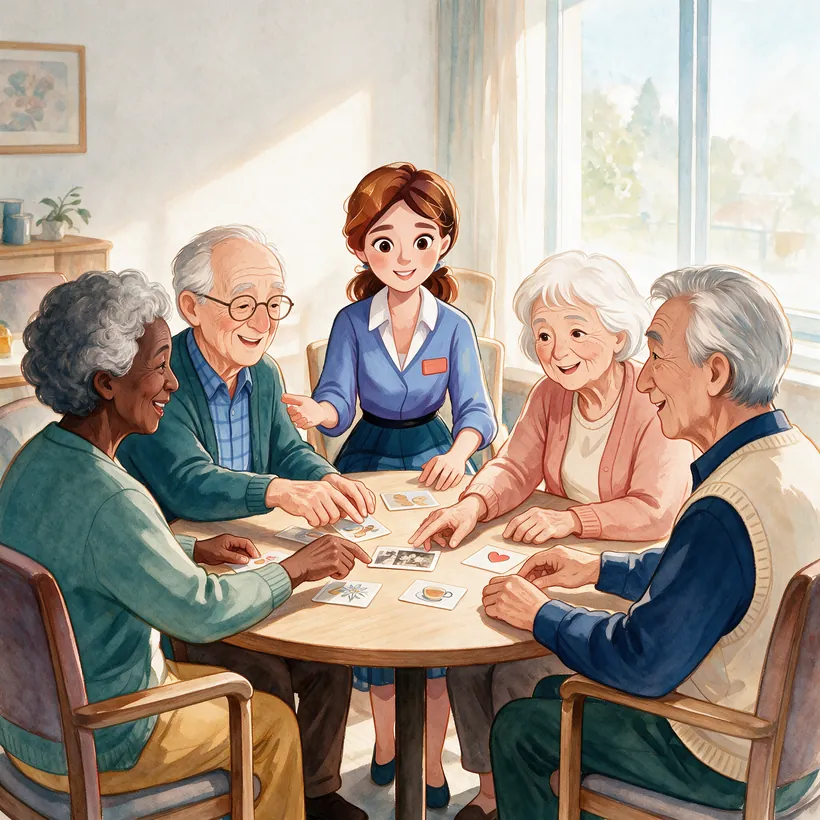
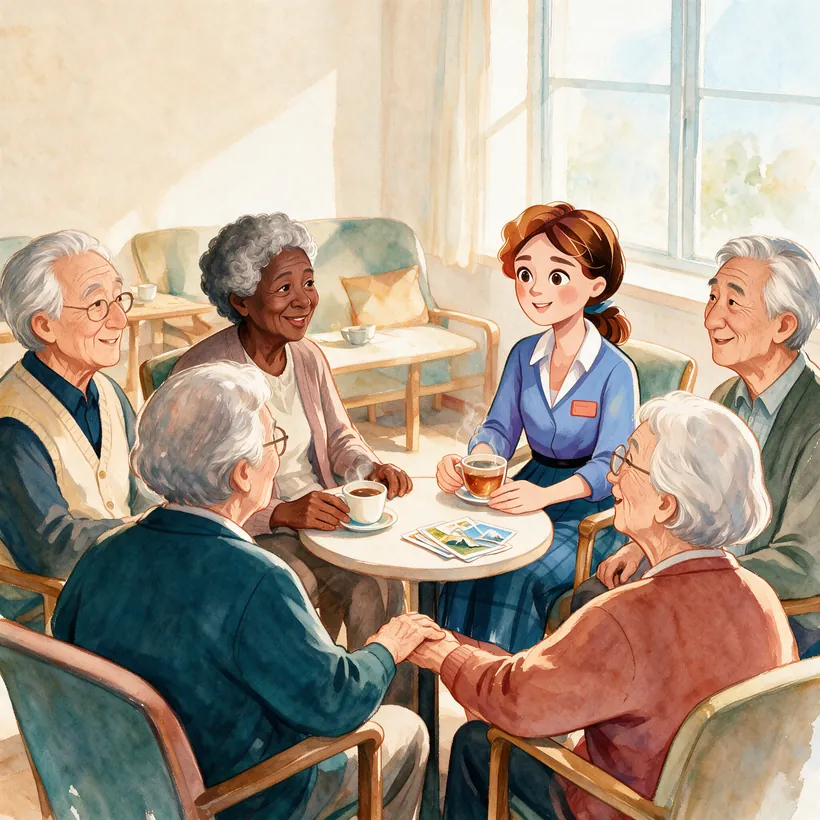
Illustration: Yessica sitting at a table with a small group of care home residents. They are looking at picture cards together, smiling and talking over a cup of tea.
Illustrative images
What it is
Not an English lesson. A shared experience.
English is the starting point, not the goal. It creates a fresh, curious situation in which residents talk, remember and listen to one another — supported by images and by a prepared facilitator.
01 English opens the conversation
Simple words, large images and easy questions give people a pleasant reason to start talking. No grammar, no tests, no corrections in front of the group.
02 Memories become stories
A photograph, a postcard or a song brings back places, flavours and people. Residents share what they want to, in whichever language feels comfortable.
03 The group creates connection
People listen, comment and laugh together. Those who speak little still take part by pointing, choosing, nodding or answering with a single word.
Benefits
An activity that works for all three.
Residents, the home and the person organising the calendar each want something different. The programme is built to answer all three.
For residents
A regular occasion to talk and spend time together
Personal memories and stories valued and heard
Curiosity and something new in the week
Light cognitive stimulation through images, words and memory
Free participation, with no obligation to speak
For the home
A distinctive activity that enriches the calendar
A professional format, prepared and adapted to the group
An experience worth telling families and visitors about
A reliable, ongoing external collaboration
The chance to assess it with a trial, with no commitment
For activity coordinators
A ready-to-run external activity for the calendar
Materials prepared and brought by Yessica
Minimal preparation required from staff
A single point of contact for scheduling and adjustments
A clear structure: 10 sessions, one a week
How it works
One session, step by step.
Each session lasts 90 minutes and follows a recognisable structure. That repetition builds confidence: after the first meeting, residents already know what to expect.
01
Welcome and opening question
It begins with a greeting and one simple question, the same for everyone. It breaks the ice and lets each person hear their own voice without any difficulty.
02
A visual or musical prompt
A photograph, a postcard, a map or a short piece of music introduces the theme of the day and brings back specific memories.
03
Guided conversation and activity
The group talks, chooses, points and compares. The activities are collaborative: no contest, no scoring, no correction in public.
04
Closing and a shared moment
It ends with a short round of words and a sociable moment, often over coffee or tea. What stays is the feeling of having spent good time together.
Each session lasts 90 minutes. The full programme is 10 sessions, one a week, adaptable to the home’s calendar.
In practice
What residents actually do.
No lecturing. Each session alternates listening, storytelling and play, with materials that are large, clear and easy to handle.
Photographs and postcards
Images that bring back places, eras and familiar faces.
Music and happy memories
Short pieces that return people to particular moments and feelings.
Places close to the heart
Villages, valleys and journeys, each recounted in its own way.
Coffee, menus and conversation
Flavours and daily habits as a starting point for dialogue.
Stories from the past
Personal accounts shared freely with the group.
Collaborative games
Matching, riddles and stories built together.
The ten themes of the programme
One theme per session. The order can be adapted to the needs and pace of the group.
01 A little about us
02 Comfort and favourite things
03 The small moments of the day
04 The people who matter
05 Music and happy memories
06 Stories from the past
07 Places close to our hearts
08 Coffee, conversation and connection
09 Games, stories and laughter
10 Celebration and shared memories
Organisation
Simple to fit into your calendar.
Everything to do with preparing the activity is handled by Yessica. All that remains for the home is the room and the scheduling.
90minutesper session
8–10residentsideal group size
10sessionsone a week
The home provides
A suitable, quiet room
Chairs and a table
The group of residents
Scheduling coordination
Any staff presence required by internal policy
A whiteboard, blackboard or screen can be useful, but is not necessary.
Yessica brings
The session, prepared and adapted to the group
Large-format images and visual prompts
Photocopies and activity sheets
Cards, flashcards and illustrated materials
Facilitation attentive to each person’s pace
All materials are included: there are no additional costs or preparations for the home.
Common doubts
The questions activity coordinators ask.
These are the objections we hear most often. None of them is a problem: the programme was built with them in mind.
Our residents don’t speak English.
They don’t need to. The sessions use simple words, images, gestures, choices and short answers. Participation is guided step by step, and nobody has to translate or build complex sentences. Most groups start from zero.
It might be too difficult.
The pace and materials are calibrated to the group, and adapt during the first session. There are no tests, assessments or public corrections: if something proves demanding, it is simplified on the spot.
It will feel like being back at school.
It is the opposite of a lesson. The sessions work with memories, images, music, conversation and collaborative activities. There are no desks, grammar exercises, homework or marks.
They may not want to speak.
Nobody is put on the spot. Listening, pointing, choosing, smiling or answering with a single word are all valid ways to take part. Quieter residents are encouraged gently and decide for themselves when to join in.
Our staff will have to prepare everything.
No. Yessica arrives with the session ready and all the materials. The home provides the room, the group and the scheduling. The preparation required from staff is minimal.
We already have a full activity calendar.
This combines novelty, conversation, memories and group experience in a format that is usually missing. The free trial session exists precisely for this: it lets your team judge whether it complements the current calendar, with no commitment.
Illustrated portrait
Who leads it
Yessica Hernandez Villegas
Language teacher, based in Ticino
For more than fifteen years Yessica has worked with people of widely different ages, backgrounds and goals in learning languages, across Mexico, Italy and Ticino. She holds a degree in Languages from the Universidad Juárez Autónoma de Tabasco and has completed extensive professional development in teaching methods, educational games, storytelling, digital tools and developing individual learners’ strengths.
She created and ran the English Conversational Club for the Comune di Origlio across three editions, a group conversation programme with adults that was positively received. She currently works with private language schools and educational organisations in Ticino.
Why this matters for your home
She prepares, she does not improviseEvery session is designed in advance, with materials built for the specific group.
She adapts the pacePrompts, timing and materials shift according to how the group responds, even mid-session.
She includes quieter peopleEncouragement, simple choices and short answers let everyone take part without being pushed.
She works visuallyLarge images, cards and illustrated materials replace written text and long explanations.
Trial session
Before deciding, try it in your own home.
A full 90-minute session, free and without commitment, with a group of residents chosen by you. It is the simplest way to see whether the activity fits.
The form will open your email programme with the request already filled in, ready to send.
FAQ
Frequently asked questions
Is English needed?
No. The programme is built for people starting from zero or with distant school memories. It uses simple words, images and gestures, and every instruction is shown as well as spoken.
Is this an English lesson?
No. English is the tool, not the goal. The aim is conversation, sharing memories and the group experience. There is no grammar, homework or assessment.
How long is a session?
90 minutes, including natural breaks. The pace is designed to stay comfortable and sustainable.
How many people can take part?
The ideal group is 8–10 residents: small enough that everyone has room to speak, large enough to create group dynamics.
What does the home need to prepare?
A quiet room with chairs and a table, the group of residents, and scheduling. Nothing else: all materials are brought and prepared by Yessica.
What materials are used?
Photographs, postcards, maps, menus, vocabulary images, illustrated cards and flashcards, photocopies and short pieces of music. All in large, highly legible formats.
How are more reserved people included?
With encouragement and without pressure. Pointing, choosing between two options, nodding or answering with a single word are all entirely valid forms of participation. Those who prefer to listen may do so.
Is a free trial possible?
Yes. A complete trial session, free and without commitment, with a group of residents chosen by the home.
How do we know if it suits our group?
Your team knows your residents best. The trial session lets you observe engagement, ease of participation and atmosphere directly, and decide on concrete evidence.
Can the programme be adapted to our needs?
Yes. Themes, order, pace and materials can all be adjusted to the group, the timetable and the habits of the home.